
One Week. Two Stages. A Turning Point for Clinician-Built AI.
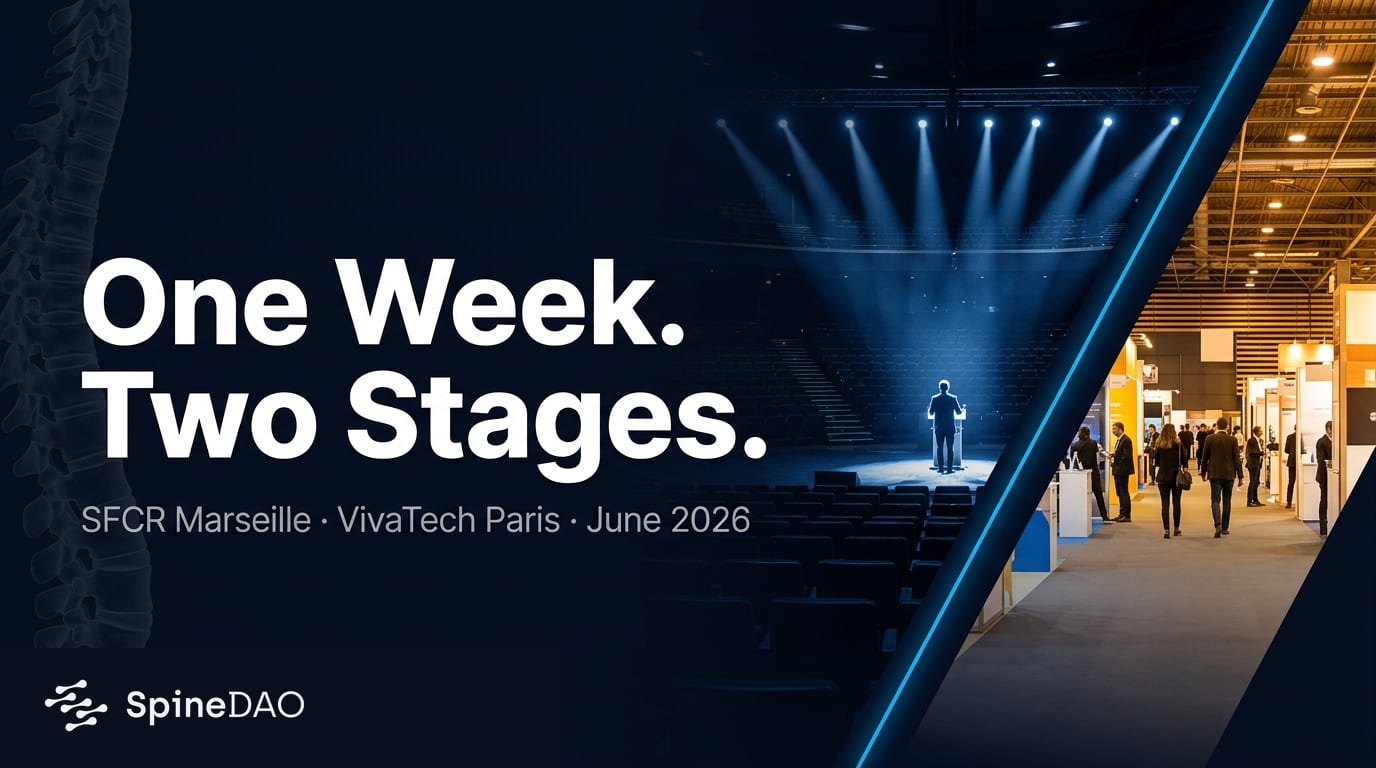
Virginie Lafage opened France's national spine surgery congress with a call to encode collective clinical knowledge. Eight days later she was on a different stage in Paris, showing the patient-facing layer of the same architecture. VECTOR won a national award in between.
June 19, 2026 · SpineDAO Editorial
Some weeks leave a mark. This was one of them.
In eight days, two SpineDAO-affiliated scientists stood on two of France's largest stages — one in front of the national spine surgical community, one in front of Europe's technology ecosystem. They carried the same argument: that clinician-built, evidence-grounded AI is not only possible, it is already here and ready to deploy.
June 11 — Palais du Pharo, Marseille
Virginie Lafage opens the SFCR national congress

The Société Française de Chirurgie Rachidienne (SFCR) chose to open its 2026 annual congress with a single question: what does the next generation of clinical intelligence actually look like?
They gave the opening lecture slot — the hour before every deformity session, every expert panel, every stats workshop — to Virginie Lafage, PhD, orthopedic clinical researcher and co-founder of Lamina. Her title: "Du jumeau numérique au graphe de connaissances : la déformation de l'adulte à l'ère de l'IA."
The argument she made is one the French spine community is uniquely positioned to understand. The parameters that define adult spinal deformity — PI–LL mismatch, T1 pelvic angle, GAP score, age-adjusted alignment targets — were built by French-speaking researchers over twenty years. What Virginie showed is that this body of knowledge is now machine-readable. The digital twin answers "what should I do for this patient?" The knowledge graph answers something different and harder: "what do we know, collectively, about this type of patient?"
She grounded this in real numbers: 766 patients in the live SpineDAO multicenter registry, 180 nodes and 351 typed relationships in the knowledge graph wired to six SpineDAO-authored papers, a synthetic validation cohort of 10,000 patient records, and a live clinical reasoning engine — "Ask Vincent" — answering structured queries in under 30 seconds from four combined sources. None of it aspirational. All of it running.
The frame she set in that first hour — structured patient data, biomechanical priors, knowledge graph, decision support — gave the rest of the congress a common architecture to argue within. Every subsequent session, from the pre-bent rod roundtable to the deformity expert files, became an instance of the same question: what do we know collectively, and how do we encode it?
Same week, Marseille — SFCR Best Scientific Communication Award
VECTOR wins 2nd Prize at the national congress
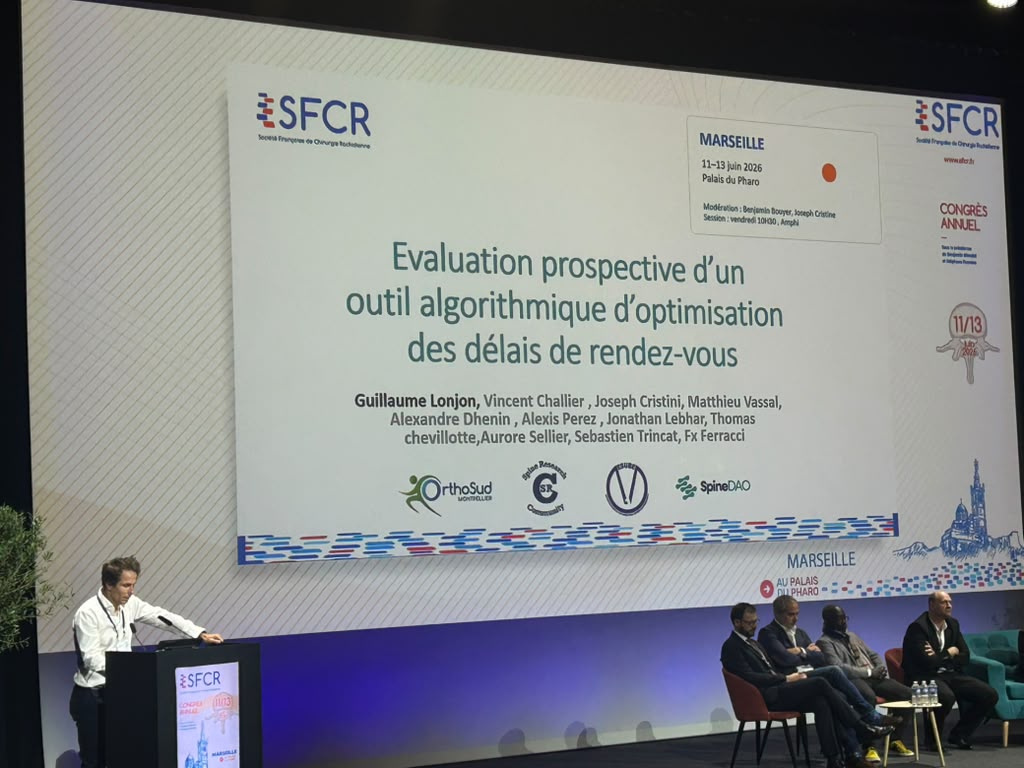
Also at SFCR, a separate SpineDAO team was in competition. Guillaume Lonjon, MD, PhD — endoscopic and scoliosis spine surgeon, OrthoSud Montpellier, ESUBE — presented the prospective evaluation of VECTOR, SpineDAO's AI patient-prioritisation software for spine clinics.
The study — "Évaluation prospective d'un outil algorithmique d'optimisation des délais de rendez-vous" — earned 2nd Prize for Best Scientific Communication from the SFCR jury.
The co-author list reflects the breadth of the collaboration: Vincent Challier · Joseph Cristini · Matthieu Vassal · Alexandre Dhenin · Alexis Perez · Jonathan Lebhar · Thomas Chevillotte · Aurore Sellier · Sébastien Trincat · F.-X. Ferracci.
The core finding is one that transforms clinic economics: approximately 90% of patients arriving at spine clinics are non-surgical candidates. VECTOR's AI risk and priority scoring — applied to questionnaire and clinical-exam data — identifies those patients early, freeing specialist time for the surgical cases that need it most. The study validates this against 500 patients across multiple French centers, under IRB-SOFCOT Ref. 21-2025.
VECTOR is pure clinical software — GDPR-compliant by design, EU-hosted, with full anonymisation and end-to-end encryption. The clinician retains full decision authority at every step. The tool assists prioritisation; it does not decide.
Congratulations to Aymeric Amelot, whose team took 1st prize — well deserved recognition at a strong congress.
June 19 — VivaTech, Paris
Lamina on stage at AI Factory France
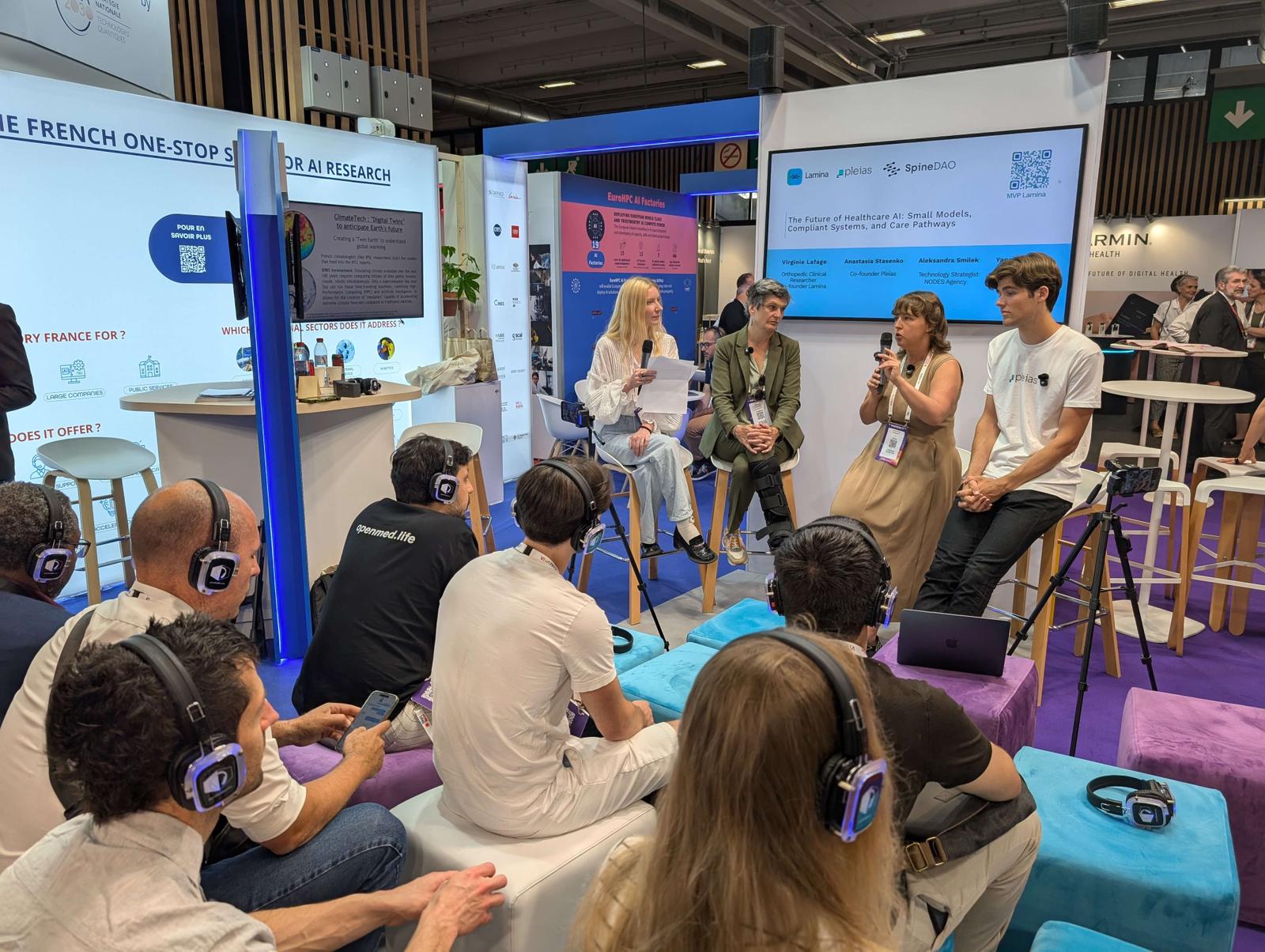
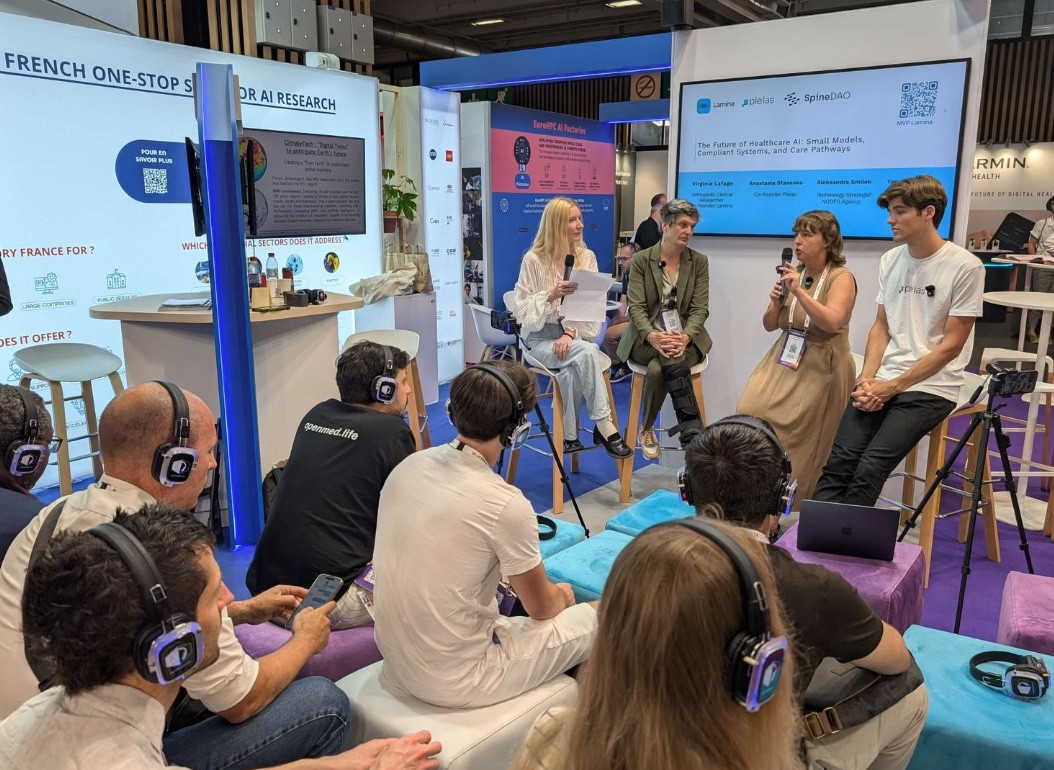
Eight days later, Virginie Lafage was on a different stage entirely — the AI Factory France stand at VivaTech, Europe's largest technology and innovation conference, held at Paris Le Bourget.
The session: "The Future of Healthcare AI: Small Models, Compliant Systems, and Care Pathways." Hosted by Aleksandra Smilek, technology strategist. Panelists: Virginie Lafage (Orthopedic Clinical Researcher, co-founder of Lamina), Anastasia Stasenko (CEO and co-founder, pleias), and Yannick Detrois (AI Scientist, pleias).
What they showed was Lamina itself — the AI clinical companion built on the insight that the hardest part of spine care is not the surgery. It is everything in between. The appointment cycle that patients live: initial consult → confusion → waiting → follow-up → more waiting. Lamina is the companion that fills that gap. Not a generic chatbot. A purposefully-built, clinician-led tool that carries the patient's full story across the care timeline and prepares both sides for the next visit.
The technical thesis that underpinned the entire session — and that SpineDAO stands behind — is this: small, open, auditable models trained on clinical evidence outperform giant generalist frontier models in healthcare pathways. Deterministic clinical logic keeps the safety-critical paths rule-based, not left to a generative model's discretion. Compliance under both HIPAA and GDPR is achievable through an open, auditable stack — not despite openness but because of it. And AI eases strained care pathways without replacing the clinician who governs them.
Lamina is a partnership between SpineDAO, Lamina, and pleias. It is currently in Beta, heading into a mid-2026 MVP focused on hardening reliability and trust before real clinical deployment.
One week. Two stages. One direction.
It would be easy to frame these as separate events. They are not. They are two proof points of the same thesis, delivered in the same week by the same community.
The spine surgical field has spent twenty-five years encoding its best knowledge into parameters — alignment targets, risk scores, complication taxonomies, outcome instruments. That knowledge is now computable. It can be queried across patients and centers. It can support triage at the clinic door. It can follow a patient through recovery. It can identify which patient needs a surgeon and which one does not.
Virginie's opening lecture at SFCR was a challenge to the French spine community to think at that scale. VECTOR's award-winning study is evidence it is working in the real world. Lamina's VivaTech panel is the patient-facing layer of the same architecture.
SpineDAO builds infrastructure for all three. A multicenter registry that belongs to the surgeons who fill it. A clinical AI layer that earns its authority through evidence. A knowledge graph that makes collective intelligence queryable. And clinical software and companions that put that intelligence where it matters — at the moment a patient walks into a clinic, or wakes up at 2am uncertain what to do next.
The field is ready. The week of June 11–19, 2026 made that visible.







%20Medium.png)


.png)
